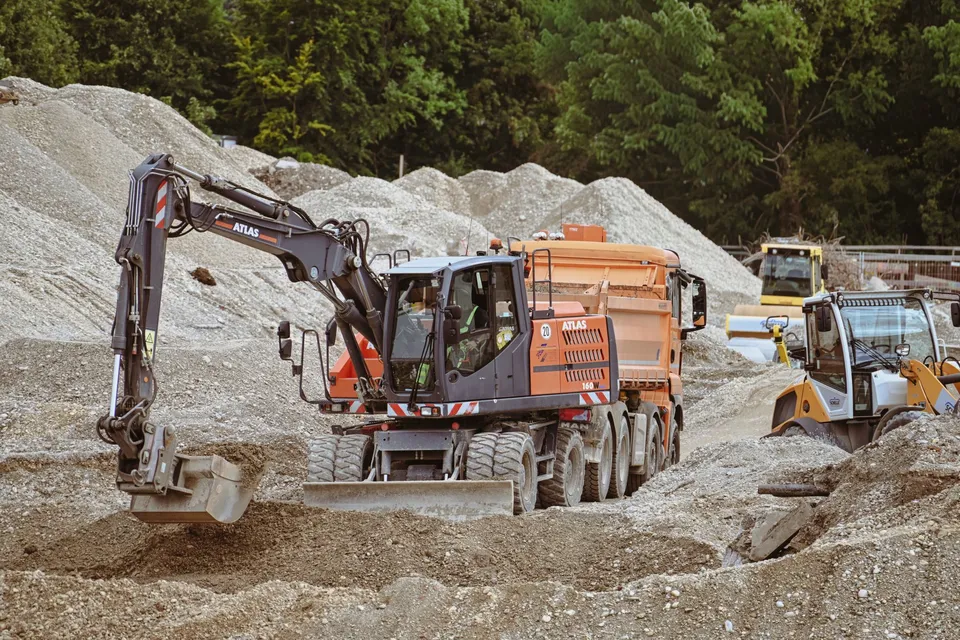
A construction job in northern Minnesota can look simple on paper—carpentry, concrete, HVAC, plumbing, electrical, equipment operation, or laboring—but the real schedule often begins before the first tool comes out of the truck. If the material is not on site, if a delivery is routed to the wrong address, or if the next trade is not ready to receive the work, a crew can lose a day without anyone doing anything “wrong.” That is why the most practical question is often not “Who is on the crew?” but “What has to arrive, in what order, and who owns the next handoff?” Installation and service work can be even more sensitive because the job may be a short appointment, a live customer visit, or a tight sequence of parts and approvals rather than a single long build.
The job changes when the delivery schedule changes
That idea matters in Brainerd-Baxter, Grand Rapids, Bemidji, Walker and across the Iron Range because northern Minnesota is not one construction market. DEED’s county profiles show 2025 construction-industry payroll jobs of 2,344 in Crow Wing County, 1,209 in Itasca, 1,534 in Beltrami and 480 in Cass. Construction accounted for 7.5% of all payroll jobs in Crow Wing, 7.3% in Itasca, 7.4% in Beltrami and 4.5% in Cass. Those are county figures, not city counts, but they still show very different labor pools and project patterns for nearby places that can feel similar on a map.
The same report also shows why employers should not treat “northern Minnesota” as a single hiring message. Itasca’s construction payroll employment rose in 2025 while Crow Wing’s dipped slightly, and the broader Northeast region had 7,341 construction-industry jobs in 2025, down 1.5% from 2024. That tells a hiring manager something useful: a role in Duluth, Ely, Hibbing, Virginia or on the North Shore may require a different travel plan, housing assumption, and start-of-shift setup than a role in the Brainerd lakes area or near Bemidji. A job posting that skips those details forces applicants to guess whether the work is at one site, several sites, or a moving route.
What employers should define before they post
For employers, the delivery schedule is not a back-office detail. It is part of the job. A good posting should spell out at least five things: where the shift starts, who controls the site, whether the work is one location or multiple stops, whether materials are staged by the employer or delivered by others, and which tasks require extra authorization. Those are not just recruiting preferences; they are how you prevent a helper, apprentice, or experienced trade worker from arriving to the wrong kind of day. A laborer on a civil crew, a carpenter on a remodel, and a service tech on an occupied building all need different instructions even if the pay scale looks similar at first glance.
This is also where regulated work boundaries matter. Minnesota DLI separates general construction experience from the authority to do electrical or plumbing work. Registered unlicensed electricians must work within the employer’s authority and under the required licensed supervision; registered unlicensed plumbers must meet their own supervision and employment rules; and residential contractor licensing is a separate question from whether someone can perform a trade task on a crew. In plain language: framing experience, shop repair experience, or good mechanical instincts do not automatically authorize a person to take over regulated work. If the next step on the job depends on a licensed person, the posting should say so.
What applicants should ask before saying yes
Applicants can use the same lens to avoid a bad fit. Ask where the shift starts, whether you report to a shop or go straight to the site, whether the job moves between locations, and who decides when your part of the work is ready to hand off. If the employer talks about “travel” or “mobility,” ask whether that means daily driving between local sites, occasional regional travel, or overnight work. The difference affects fuel costs, sleep, family routines, and whether the job still makes sense after the first month. Those questions are especially important in rural and small-town parts of northern Minnesota, where the next site may be a long drive rather than a few blocks away.
Commuting data show why the answer is rarely one-size-fits-all. In the 2020–2024 ACS figures reproduced by DEED, 84.1% of Crow Wing resident workers worked in their county of residence, with a mean travel time of 23.1 minutes. In Itasca, 82.8% worked in county and the mean travel time was 24.1 minutes. Those are all-worker figures, not construction-only figures, but they remind job seekers that a “reasonable commute” on a map can still become a hard promise when the worksite changes mid-project or the meeting point moves farther from home.
Winter does not erase the work; it changes the sequence
Northern Minnesota’s winter does not make construction disappear, but it does change what can happen on time and in what order. DEED’s historical Northeast data show heavy and civil engineering construction with average quarterly employment ranging from 1,273 in the first quarter to 2,110 in the third, with an annual average of 1,718. That seasonal swing is a reminder that outdoor work, earthwork, and road-related projects often cover different ground in different months. It is not proof that every crew shuts down in winter, and it is not a guarantee that summer work will stay busy forever. It does, however, explain why a posting should say whether the job is site-based, weather-sensitive, or likely to shift into maintenance, fabrication, or indoor service work.
That same seasonal logic reaches into pay and housing decisions. In the DEED county data, 2020–2024 median monthly rent was $971 in Crow Wing and $988 in Itasca, while median owner-occupied home values were $306,800 and $225,200. Those numbers do not tell a worker whether a vacancy exists today, but they do show why relocation is more than a wage comparison. A person considering a job in Brainerd, Grand Rapids, or anywhere else in the region needs to know whether the work is likely to be steady, whether the employer expects local residence, and whether the project pattern justifies the commute or rental search.
A better way to read a job listing
A strong northern Minnesota construction listing is not just a wage and a trade title. It answers the practical questions that keep a job moving: Where does the day begin? What is the site type? What work is already complete? What can the applicant actually do on day one? What must wait for a licensed person, a delivery, or another crew? When those answers are clear, employers waste less time screening people who cannot fit the schedule, and applicants avoid saying yes to a role that depends on travel, housing, or authorization they did not expect.
That is the real value of a well-written posting in this region. It respects the fact that construction is a sequence of interdependent work, not a single occupation. It also treats applicants like adults who need the whole picture, not just the hourly rate.
If you are hiring, use the Request Candidates page on northernmnconstructionjobs.com to describe the trade family, project location, schedule, and coverage you actually need. If you are looking for work, send your skills, availability, and preferred work style to Express, or call Express at 218-967-5669 or email apply@expressprosmn.com.