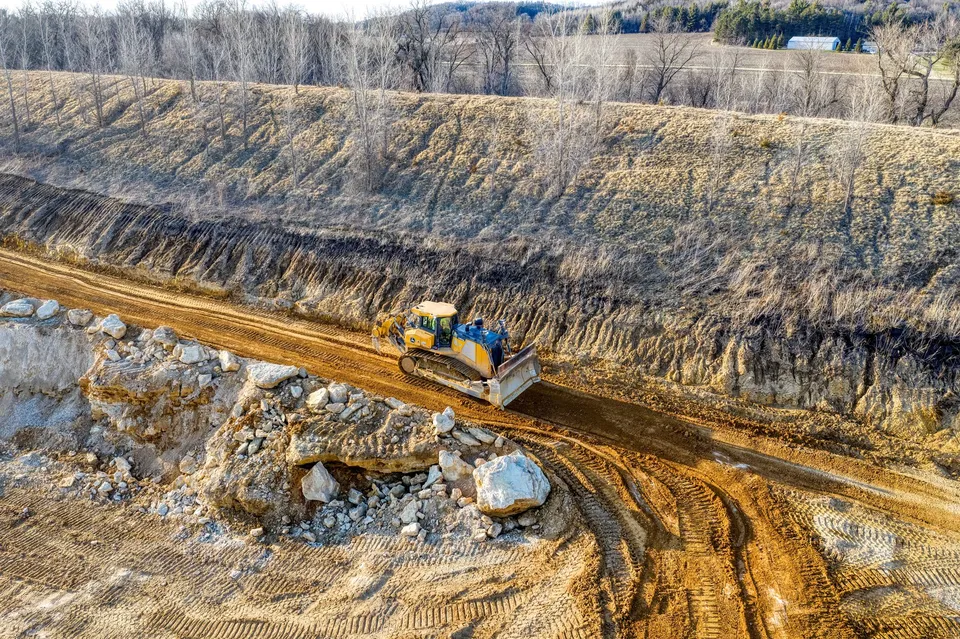
A construction title can sound simple and still hide three very different days. One worker may report to a shop, load materials, and head out to a changing list of sites. Another may spend most of the week on one commercial or civil project. A third may make short service calls into occupied homes or businesses. In northern Minnesota, that setting often matters more than the word “construction” on the posting, because it changes the commute, the tools, the supervision, the schedule, and even what kind of experience actually counts.
The job title does not tell the whole story
That difference is easy to miss when you compare openings across places like Brainerd/Baxter, Grand Rapids, Bemidji, Walker, and the Iron Range. DEED’s 2025 county profiles show construction-industry payroll jobs of 2,344 in Crow Wing County, 1,209 in Itasca County, 1,534 in Beltrami County, and 480 in Cass County. Those are jobs in construction establishments, not counts of carpenters, electricians, or other individual trades, and they omit many self-employed workers. The same title can land in a much larger or much smaller local labor market depending on where the crew actually works.
That is why a posting for a carpenter, laborer, operator, HVAC helper, or service tech should be read as a work setting first and a trade label second. On one job, the main task may be framing or concrete placement. On another, it may be installing equipment in an existing building. On a third, the worker may be supporting shop fabrication or equipment repair that feeds the field crews. A shop welding a component for installation, or a mechanic repairing construction equipment, has a clear construction connection even when the establishment itself is classified as manufacturing or repair rather than construction.
Three settings, three different kinds of readiness
Field production work is the most familiar version: a crew builds, places, moves, or installs something that is progressing across a site. That can mean residential framing, commercial interiors, civil and infrastructure work, or utility-related installation. In that setting, the employer often cares about layout, access, deliveries, and how well a worker coordinates with other trades. If a project is in its early or rough-in phase, reliability and handoff skills matter as much as raw speed.
Shop and support work is different. The pace may be steadier, the setting more controlled, and the handoff to the field more important than customer interaction. A fabricator, welder, equipment mechanic, or materials coordinator may never pour concrete or set trusses, yet still be essential to the schedule. This is where a résumé can look “construction-adjacent” without being a substitute for the exact job the employer needs.
Installation and service work adds another layer. Jobs that move from site to site or from customer to customer often depend on communication, access, and the ability to work around occupied spaces. A remodel in a lived-in house and a service call at a business do not require the same pace or the same kind of customer judgment as a new-build crew on open ground. DEED’s regional analysis shows why this matters in northern Minnesota: construction-industry employment in the Northeast fell to 7,341 jobs in 2025, down 1.5% from 2024, while the same region still had 8,440 construction and extraction occupation jobs in first-quarter 2026. Those are different measures, and neither one tells you whether the next opening is in the field, the shop, or on service work.
Travel is part of the job description, not a side note
Northern Minnesota workers know that distance is not an abstract issue. DEED’s 2020–2024 ACS data show that 84.1% of Crow Wing County workers worked in their county of residence, while 14.8% worked elsewhere in Minnesota; Itasca County was similar, with 82.8% working in county and 15.4% elsewhere in Minnesota. Mean travel time to work was 23.1 minutes in Crow Wing and 24.1 minutes in Itasca. Those figures cover all workers, not just construction, but they explain why a role that starts at a shop, changes job sites, or requires early travel can feel very different from a local call-in job.
Housing can shape that decision too. In the same DEED data, median monthly rent was $971 in Crow Wing and $988 in Itasca, while 44.5% of Crow Wing renters and 58.1% of Itasca renters spent at least 30% of household income on rent. A worker deciding whether to take a job in Brainerd/Baxter, Grand Rapids, or farther up the road may need to think about more than base pay. They may need to know whether the shift starts at a central shop, at the site, or at multiple stops; whether a personal vehicle is expected; whether the route changes during the week; and whether the schedule is steady enough to support the commute.
When the role touches licensed trades, the setting matters even more
A helper title is not the same thing as a license, and a license is not the same thing as employer authority. Minnesota’s Department of Labor and Industry is clear that electrical work and plumbing work have their own supervision and registration rules. For example, DLI says a registered unlicensed electrical worker must work under the employer’s authority and under a person licensed for that work, and unsupervised electrical work is prohibited. DLI also says registered unlicensed plumbers must be registered, work under direct supervision, and be W-2 employees of an authorized plumbing contractor, restricted contractor, or registered employer working on its own premises.
That means the question is not simply, “Have you ever helped on electrical or plumbing jobs?” It is, “What tasks are you authorized to perform on this crew, under whose supervision, and at what kind of site?” A person with solid mechanical or construction experience may still need the right registration, the right employer relationship, or the right licensed supervisor before they can do the work legally. That distinction protects both the worker and the employer from treating transferable experience as automatic permission.
Seasonal work changes the ask, but not every job freezes in winter
Northern Minnesota construction does not shut down all at once when the weather turns. The work changes by type. DEED’s study of 2019–2023 Northeast Minnesota quarterly payroll data found heavy and civil engineering construction ranged from 1,273 average jobs in the first quarter to 2,110 in the third quarter, with an annual average of 1,718. That kind of swing is exactly why a road, earthwork, or utility role should be discussed differently than indoor renovation, service work, equipment maintenance, or fabrication.
For an employer, that means the job description should separate expected outdoor exposure, likely travel, and possible schedule variation from any year-round work assumption. For an applicant, it means a winter hiring conversation should ask whether the role is tied to a project phase, a route of service calls, a shop backlog, or an ongoing crew. The words “construction” and “full time” do not answer those questions by themselves.
A better way to judge the opportunity is to ask four practical questions: Where does the shift begin? What kind of work setting is it—shop, site, service, or mixed? Who supervises the regulated parts of the job? And what travel, schedule, and housing assumptions come with the offer? If you can answer those four questions clearly, you are much closer to knowing whether the job fits your life and your trade background.
If you want help matching a role to your experience, call Express and compare the work setting before you compare the wage.